
Concrete Shell Design in SAP2000
Applying the Eurocode 2 Sandwich Model for Slabs
SAP2000 offers integrated capabilities for the design of concrete shells in accordance with Eurocode 2 (EN 1992-1-1:2004 and EN 1992-2:2005). This allows users to perform automated design at the object level for structures that have been modeled and analyzed within the program. The design process utilizes material properties and element forces recovered directly from the model database, applying them according to user-defined or default design settings.
Understanding Concrete Shell Design in SAP2000
Concrete shell design in SAP2000 involves several key steps:
- Calculating the required amount of reinforcement in the membrane layers to resist bending moments and axial forces.
- Checking the shear demand/capacity ratio at the joints of the shell element.
- Designing the amount of shear reinforcement needed to resist shear forces at the joints.
The program provides graphical and tabular output formats to help engineers study stress conditions and assess element adequacy.
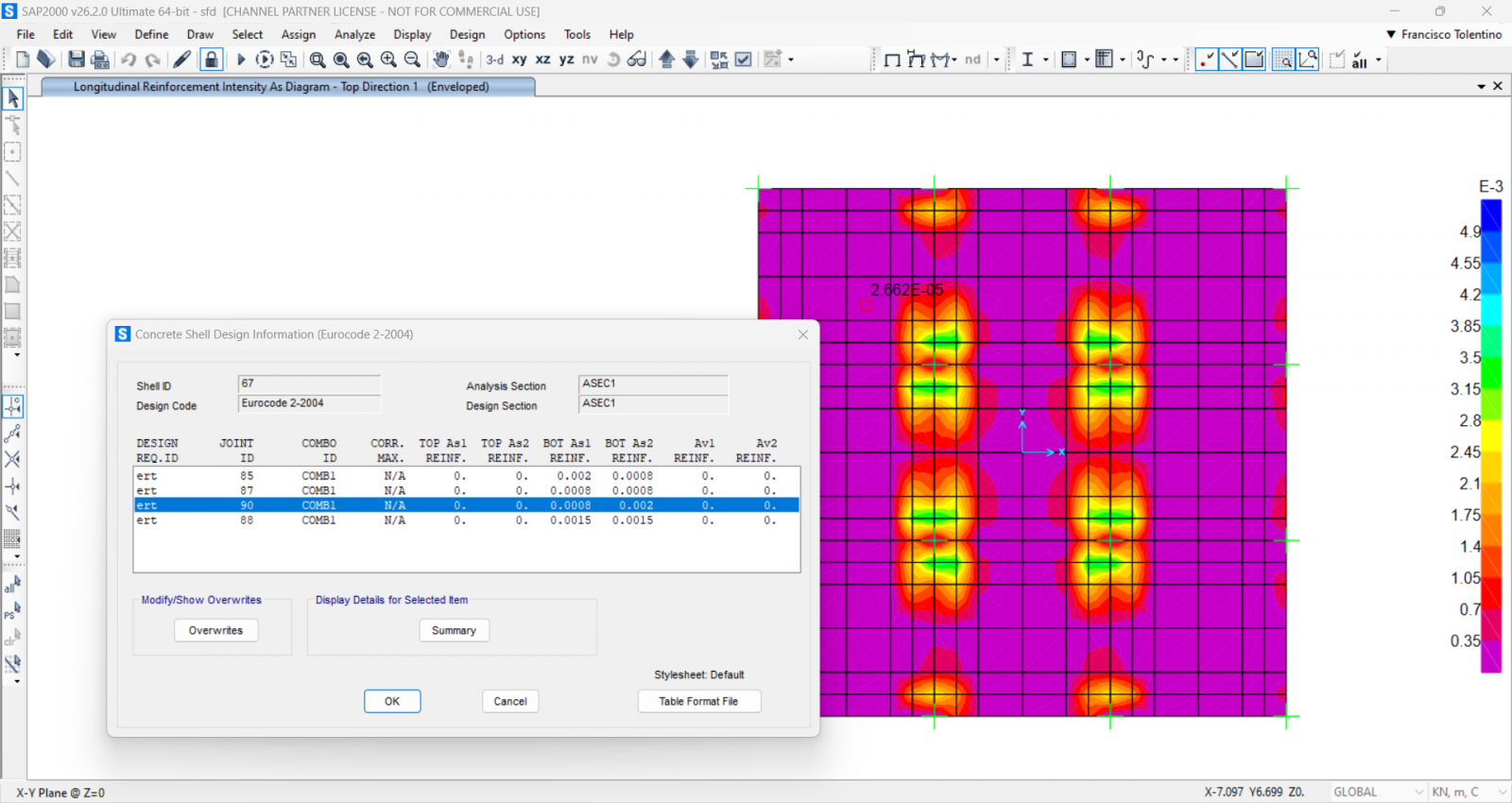
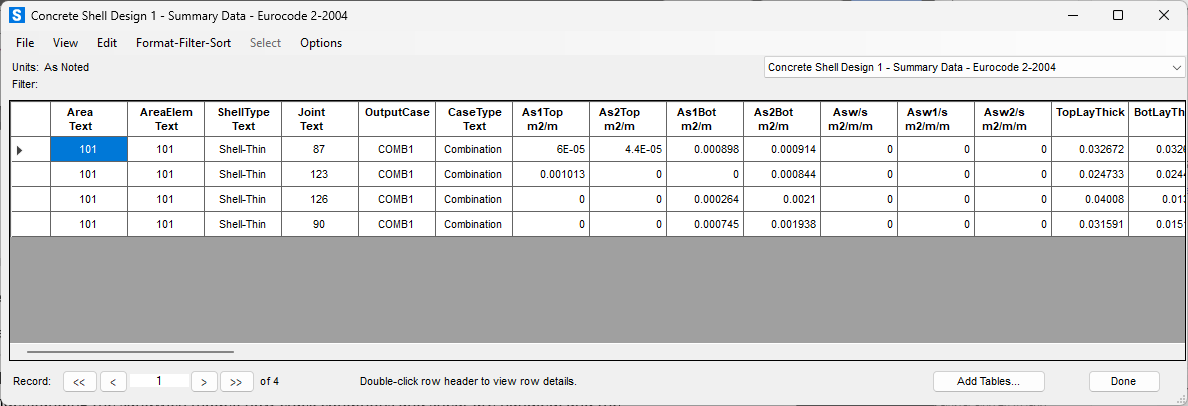
The Three-Layer (Sandwich) Design Model
A core concept in the SAP2000 shell design algorithm for Eurocode 2 is the idealization of the shell element as a three-layer (sandwich) model. This model consists of two outer layers and an uncracked core.
- The outer layers (top and bottom) are assumed to carry bending moments and membrane forces. Their dimensions and the location of reinforcement are key parameters in the model.
- The core is assumed to carry the shear forces.
The design implementation assumes there are no diagonal cracks in the core. Under this assumption, a state of pure shear develops in the core, meaning shear forces at a section do not affect the in-plane forces in the outer layers. Consequently, the in-plane reinforcement is not enhanced due to shear, and no transverse reinforcement is provided in the core itself for this pure shear case.
It is important to note a limitation in the software: the design will not be performed if the sum of the concrete covers of the top and bottom reinforcement exceeds 95% of the shell section thickness. This is to prevent numerical difficulties.
Forces and Concrete Strength in the Sandwich Model
Within the sandwich model, the forces required to be resisted by reinforcement and concrete in the outer layers are determined based on the total stress resultants:
- Membrane forces N11, N22, N12;
- Flexural moments M11, M22, M12;
- Shear forces V1, V2.
The concrete compressive strength, fc, used in the design for the outer layer is determined based on whether the concrete is considered uncracked or cracked.
- For uncracked concrete, fc is taken as the characteristic compressive cylinder strength fck.
- For cracked concrete, fc is typically computed as fcc2 = ν₁fck, where ν₁ is a strength reduction factor. The Eurocode provides a formula for ν₁ based on fck, or its value can be found in the National Annex.
- For certain design cases where the concrete is assumed cracked, fc is interpolated between fcc1 (fck) and fcc2 based on models that relate compressive strength to tensile strain.

The SAP2000 design algorithm uses an iterative process to determine the thickness of the top and bottom layers and the optimum amount of reinforcement, ensuring consistency between assumed and calculated layer thicknesses. For shell elements with a single layer of reinforcement, this layer is assumed to be at the middle of the section, and the design amount is reported as the top layer, with the bottom layer reinforcement taken as zero. The concrete cover for this single layer in directions 1 and 2 is taken as half the shell thickness.
Shear Design and Interaction with Longitudinal Reinforcement
Shear design is a critical aspect covered by the software. The design process checks the shear demand/capacity.
- If the shell element is determined to be uncracked, the design is satisfied, and nothing further needs to be checked for shear.
- If the shell element is determined to be cracked, design for longitudinal and transverse reinforcement proceeds.
SAP2000 offers two methods for shear design:
- Method 1: This method first considers increasing the longitudinal reinforcement to enhance the concrete shear capacity, as permitted by Eurocode 2. However, the total longitudinal reinforcement ratio (sum of top and bottom reinforcement in a direction divided by the effective width) is limited to 0.02. If, even with this maximum longitudinal reinforcement, the concrete shear capacity is still insufficient, shear reinforcement will be provided. If concrete shear capacity is sufficient after increasing longitudinal reinforcement (i.e., calculated required ρl <= 0.02), the top and bottom longitudinal reinforcement areas are increased proportionally. The code allows this increase in membrane forces (resulting from the strut and tie model used for shear) to be substituted by a shift in the longitudinal reinforcement. An option is available in the preferences to include this additional tensile force or not.
- Method 2: This method directly calculates the required shear reinforcement without considering the option to increase longitudinal reinforcement to boost concrete shear capacity.
If shear reinforcement is required (either by choosing Method 2 or if the longitudinal reinforcement limit in Method 1 is exceeded), the software calculates the required area of shear reinforcement.
Design Preferences
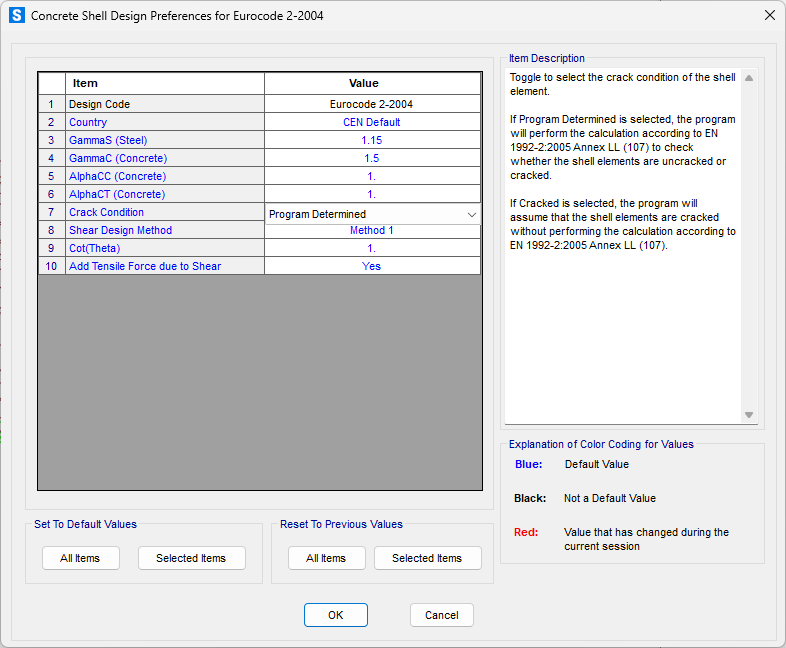
SAP2000 allows users to control various design parameters through design preferences. For concrete shells designed to Eurocode 2, key preferences include:
- Crack Condition: You can choose whether the program Program Determined (calculating cracking according to EN 1992-2:2005 Annex LL) or Cracked (assuming cracking without calculation).
- Shear Design Method: You can select either Method 1 (increase longitudinal reinforcement before providing shear reinforcement, up to a limit) or Method 2 (directly calculate shear reinforcement).
- Nationally Determined Parameters (NDPs): Eurocodes allow for national choices on certain parameters. SAP2000 uses default NDP values for different countries, listed in an appendix. Some of these parameters can be modified via design preferences. Examples of NDPs include partial factors for materials (γC, γS), maximum yield strength (fyk), values for αcc, CRd,c, vmin, cteta, and v1.
Design Overwrites
In addition to global preferences, SAP2000 allows applying Design Overwrites to selected area objects, providing more granular control over design parameters for specific parts of the model. When an overwrite is applied, any previous auto-select section assigned to the area object is removed.
Relevant overwrites for concrete shell (slab) design include:
- Design Section: Specifies the design section for the selected area objects.
- Number of Reinforcement Layers: Specifies the number of reinforcement layers for the selected area objects. Setting this to 0 means the value is taken from the area section properties.
- Concrete Cover (Top): Specifies the concrete cover from the top concrete fiber to the center of the top reinforcement in Direction 1 and Direction 2. Setting this to 0 means the value is taken from the area section properties.
- Concrete Cover (Bottom): Specifies the concrete cover from the bottom concrete fiber to the center of the bottom reinforcement in Direction 1 and Direction 2. Setting this to 0 means the value is taken from the area section properties.
These overwrites are particularly useful for refining the design of specific slab areas where local conditions may require adjustments to parameters like cover or number of layers.

Relevance to Slab Design
Slabs are common structural elements in buildings and civil engineering works covered by EN 1992-1-1.
Understanding the sandwich model, how crack conditions and shear are handled, and the available preferences and overwrites is crucial for effectively using SAP2000 to design concrete slabs according to the Eurocode 2 standard.
In conclusion, SAP2000's integrated concrete shell design for Eurocode 2, based on the sandwich model, provides a powerful tool for designing structural elements like slabs. Familiarizing yourself with the design algorithms, understanding the impact of crack conditions and shear design methods, and knowing how to utilize the design preferences and overwrites will enable you to perform accurate and efficient concrete slab design within the software.
Design Variables and Nomenclature
The design variables shown in the image below are explained in the attached file.

 CSD-EC-2-2004.pdf