
Assessment of seismic vulnerability according to EC8 in the Seismic Performance Finder (VIS)
The assessment of seismic vulnerability of existing structures is a central topic in civil engineering, especially in regions with significant seismic risk. Eurocode 8 (EC8), particularly Part 3, establishes the foundations for this type of analysis, proposing methodologies compatible with the real behavior of existing buildings.
In this context, the Seismic Performance Finder (SPF), integrated in VIS, emerges as a practical tool that allows transforming a detailed structural model into a quantitative assessment of seismic performance.
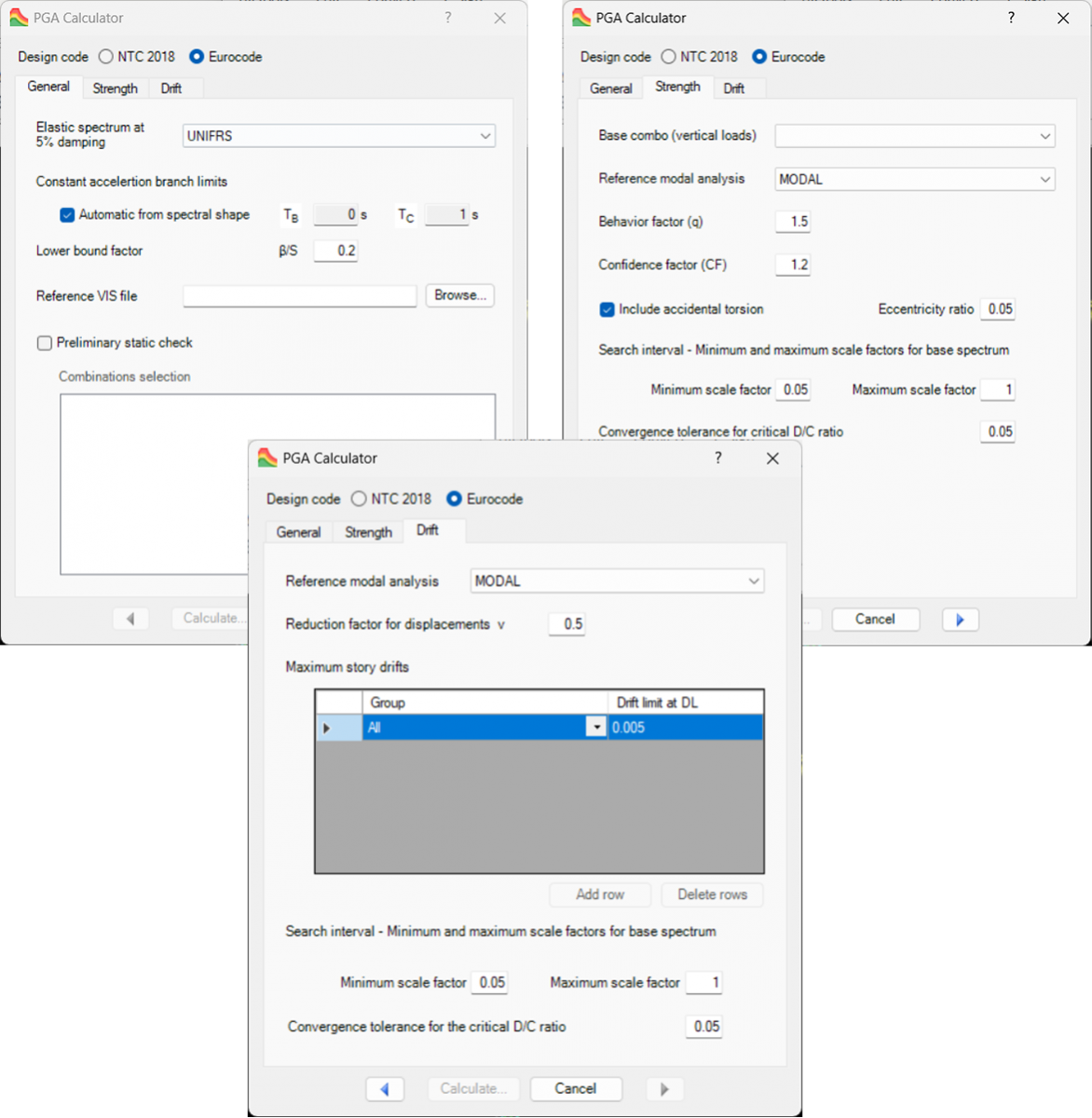
Below we can see some images of SPF:
.png)
How the method works
The SPF is based on a relatively straightforward approach: it applies response spectrum analyses, progressively increasing the seismic intensity until the structure reaches a limit state.
In practice, the program performs successive iterations and, in each one, calculates the ratio between demand and capacity (D/C) of the structural elements. The critical point is reached when this ratio approaches 1.
The process is developed in two complementary stages:
.png)
Resistance assessment
In the resistance phase, the objective is simple: to find the PGA value (peak ground acceleration) that causes the first failure in a structural element.
For this, the program considers:
- the behavior factor (q), which represents in a simplified way the ductility of the structure
- the confidence factor (CF), which reduces resistances to account for uncertainties
- a modal analysis with response spectrum
- the possibility of including accidental torsion
- optionally, a preliminary static verification
The result is a critical resistance PGA, corresponding to the onset of structural failure.
.png)
.png)
Drift assessment
In the second phase, the focus shifts from resistance to deformation.
The program again performs iterative analyses, but now checks whether the interstory displacements exceed the limits defined by the user.
The result is a critical deformation PGA, typically associated with damage levels or loss of functionality.

Where this method works well
An essential point — often overlooked — is understanding that this type of approach is not universal.
The method used in SPF works best when the structure has a relatively “regular” behavior, that is:
- uniform distribution of mass and stiffness
- simple geometry
- absence of abrupt discontinuities
- common structural systems (frames, walls, or mixed systems)
In these cases, it makes sense to use a global q factor and assume that the response can be adequately represented by linear analysis.
Applicability limitations (what EC8 implicitly states)
When the structure deviates from this ideal behavior, important limitations begin to emerge. EC8 does not directly prohibit this type of method, but it makes it clear that it is more suitable for regular structures and that, in more complex cases, more advanced methods should be used.
Some typical situations where SPF should be used with caution:
- Irregularity in height: such as “soft stories” or abrupt stiffness variations
- Irregularity in plan: L- or U-shaped buildings or with eccentric masses
- Structures with brittle behavior: the q factor may not represent reality
Even when SPF allows considering effects such as accidental torsion, this remains a simplified approximation of real structural behavior.
Conclusion
The Seismic Performance Finder is a highly effective tool for translating a structural model into a clear indicator of seismic vulnerability, following the principles of EC8.
However, its use should always be accompanied by a critical assessment of the problem. The approach is particularly suitable for regular structures and preliminary studies, but it may become limited when structural behavior is governed by irregularities or nonlinear phenomena.
In summary, the SPF should be seen as:
- An excellent decision-support tool
- but not as a substitute for a more rigorous analysis when the structural complexity requires it