
Staged Construction – Using “Pour Concrete” and “Remove Forms” Operations
In a previous article, we explored the use of the Guide Structure feature to accurately model the placement of components, such as a concrete slab, onto precast girders that have already deflected under their own weight.
This article builds on that foundation, delving into two powerful operations in CSI Bridge designed for this purpose: Pour Concrete and Remove Forms. We will cover how these tools are used to model the time-dependent effects of concrete curing and the crucial transfer of loads from temporary formwork to the permanent structure, providing a more complete picture of realistic construction simulation.
Pour Concrete Operation
Purpose & Role: The Pour Concrete operation simulates the placement of fresh concrete within the structural model. This operation is used to represent the instant that a segment of concrete (such as a slab, diaphragm, or deck region) is cast in situ, supported by temporary forms or scaffolding. Upon activation:
- The poured element is initialized with a construction age of zero, and its stiffness and strength are defined based on material properties for fresh concrete, either user-specified or code-defined.
- The weight of the concrete segment is transferred to the supporting girders rather than being carried by the segment itself until the forms are removed.
- Time-dependent properties such as modulus of elasticity and creep commence tracking from this event, enabling simulation of the aging process and deformations.
Remove Forms Operation
Purpose & Role: The Remove Forms operation represents the removal of temporary supports (forms or falsework) from a recently cast concrete segment. The operational sequence is as follows:
- When the Remove Forms step is activated, the self-weight and any other superimposed permanent or temporary loads applied during the pour are transferred from the girders to the new concrete segment, which now supports itself and participates in the structural system.
- The current time, creep, and shrinkage effects of concrete continue accumulating based on the element’s age.
- The ability to stage the removal of forms enables simulation of a more realistic construction timeline, including any temporary stacking of segments or delayed transfers of load.
Example
This example is based on the same model used in our previous article on the Guide Structure operation. The complete sequence of operations can be seen in the Load Case Tree below.

- Stage 1: As covered in the dedicated article, this stage involves adding the slab as a Guide Structure and erecting the U-Girder.
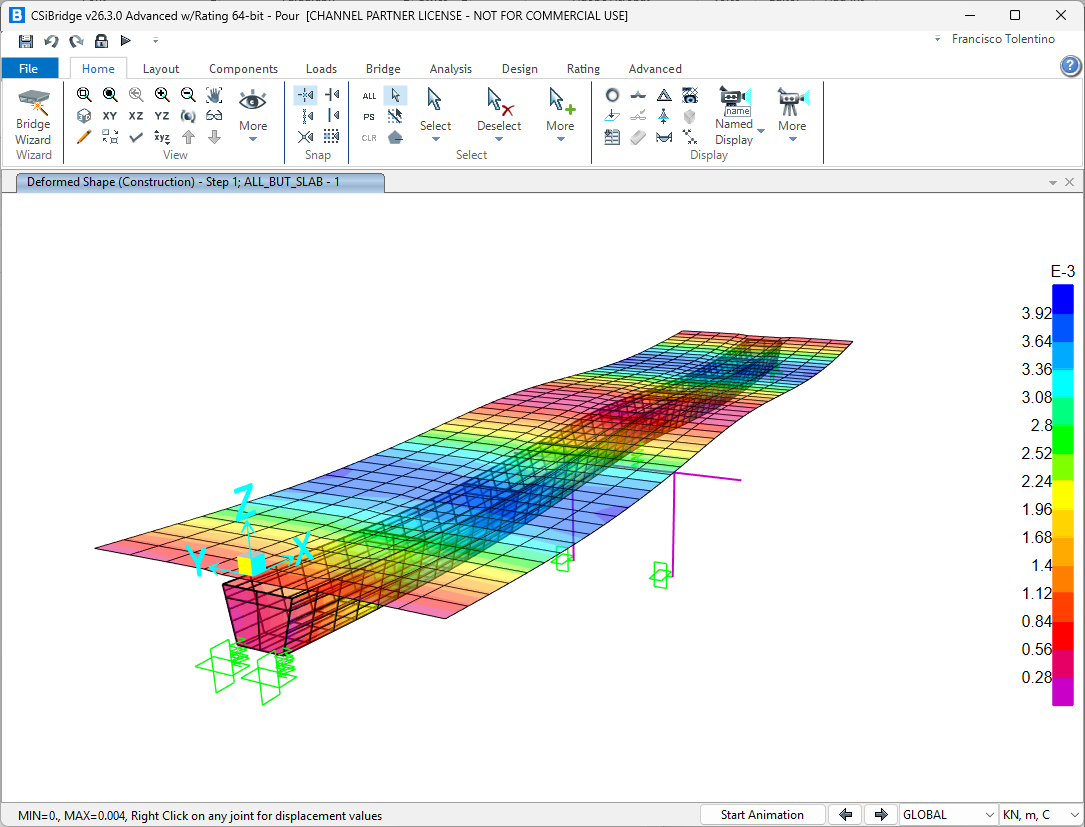
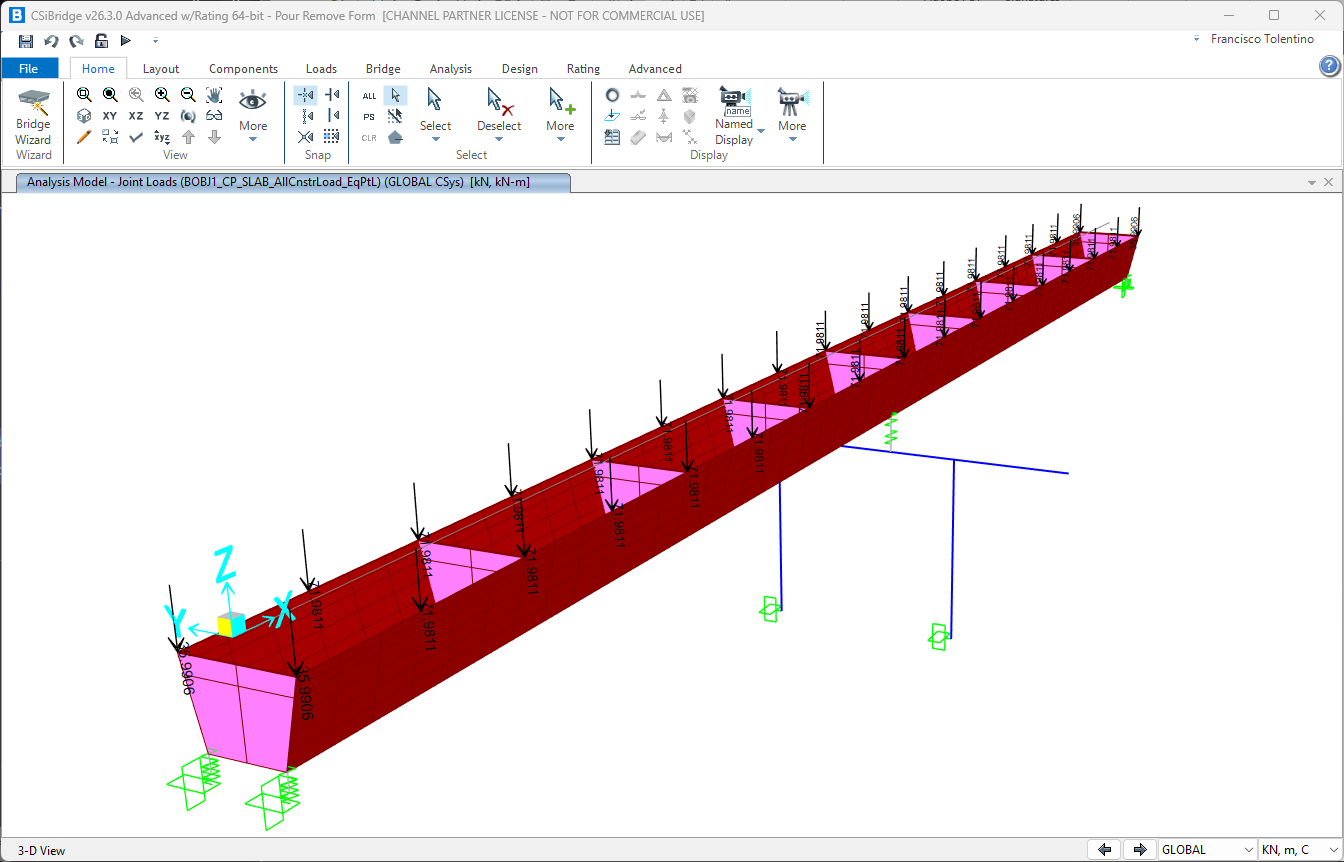
- Stage 2: This stage simulates the pouring of the concrete slab. Point loads, representing the total weight of the wet concrete, are applied directly to the girder. This correctly models the formwork transferring the fresh slab's weight to the supporting girder.

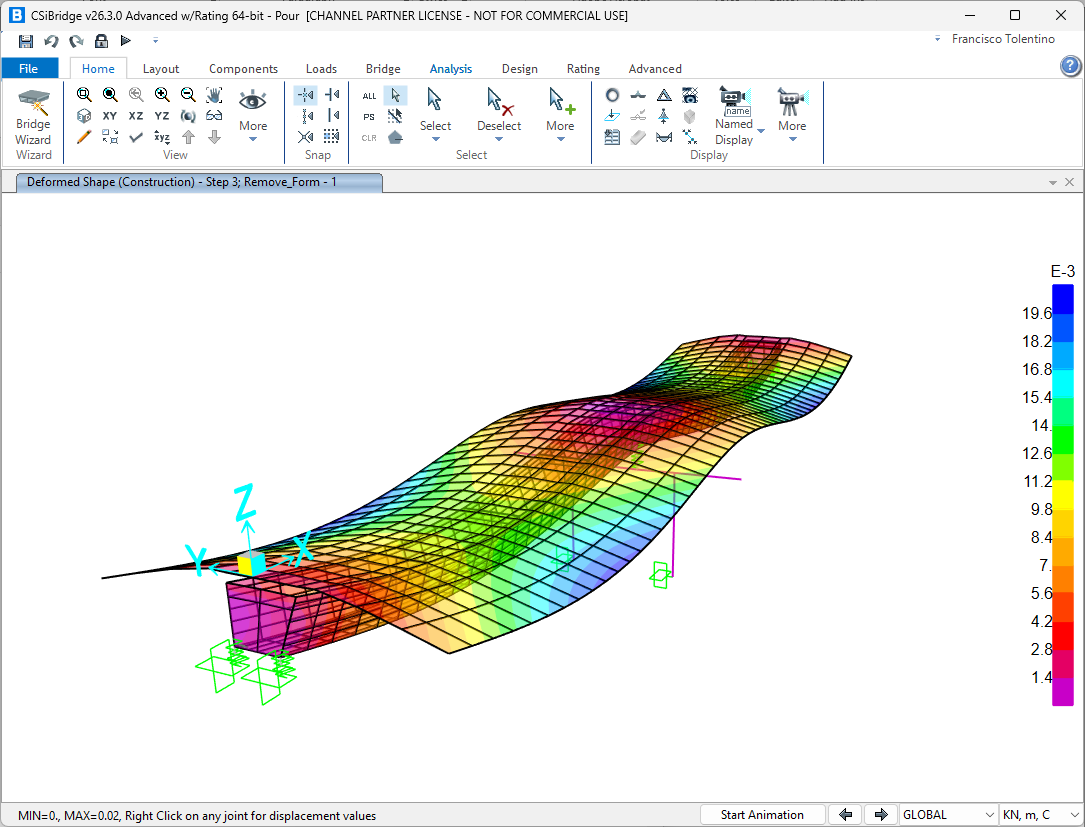
- Stage 3: In this final stage, the formwork is removed. The temporary point loads on the girder are deactivated, and the slab's inherent self-weight is now applied to the slab object itself, which has cured and become self-supporting.
Conclusion
The Pour Concrete and Remove Forms operations in CSI Bridge enable engineers to model construction processes with high fidelity, capturing the real behavior of staged concrete structures. By simulating the timing of load transfers and the evolution of concrete properties, engineers achieve a much more accurate prediction of structure performance, including stresses, deformations, and long-term durability effects. These features are essential for modern analysis and design of bridges and complex cast-in-place concrete systems.